Tiskre kihistu
ingl. k. Tiskre Formation
| Tüüp ja tase | regionaalne litostratigraafia (kihistu) |
|---|---|
| Staatus | kinnitatud standard |
| ESK kinnitatud | Jah |
| Autor | Öpik (1933) |
| Indeks | Cm2ts |
| Indeks | Ca1ts |
| Nime päritolu | Tiskre asula Põhja-Eestis |
| Kuulub | Balti litostratigraafia (Kambrium) |
| Sisaldab | Kakumäe kihistik Rannamõisa kihistik |
| Suhteline vanus | Kambriumi 3. lade |
| Litoloogia | Hele peeneteraline liivakivi ja aleuroliit |
| eMaapõu ID | 218 |
Stratotüübid
holostratotüüp: Rannamõisa pank ( m) | Mens, 1992 (comp) |
Kirjeldus
From Mens, K., & Pirrus, E. (1997):
The Tiskre Formation in the current use is interpreted as a unit containing the Tiskre beds (= Diplocraterion Sandstone) by Öpik (1933) or the Tiskre Formation by Männil (Männil 1958a) together with the Kakumägi beds (Scenella Zone) by Öpik (1933) or the Kakumägi Member of the Pirita Formation by Männil (Männil 1958a).
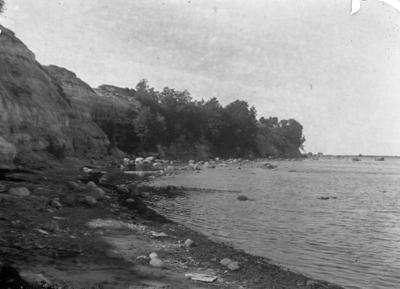
The Tiskre Formation is distributed in northern and western Estonia (Figs. 18, 19) where it overlies the Lükati Formation. The lower boundary is lithologically abrupt and marked by a change from argillaceous rocks to sandstones. Between Muraste and Aseri, lenses of Mickwitzia conglomerate occur at that level. Its type section is an exposure at the southern end of the Rannamõisa Cliff, 14 km west of Tallinn (Mens & Pirrus 1977). The formation is at its thickest (20 m) in the stratotype area.
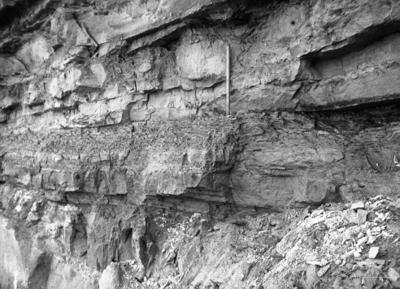
The Tiskre Formation consists of light-coloured massive or thick-bedded sandstones with thin interbeds of greenish-grey argillaceous rocks (Photo 16). Within the outcrop belt the Tiskre Formation is divided into the Kakumägi (lower) and Rannamõisa (upper) members.
The Kakumägi Member is represented by poorly sorted sandstones with an admixture of clayey material. Conglomerate lenses within the sandy sequence are locally present. In the basal part, sandstones are often well cemented with dolomitic cement. Bedding is mostly lenticular, casts of mud cracks, slump-rolls and ripple marks are common.
The Rannamõisa Member consists of horizontally bedded winnowed fine-grained or very fine-grained sandstones with thin interlayers of argillaceous rocks. Glauconite is present. Ripple marks and convolute bedding occur throughout the member (Pirrus 1978).
Viited
Meidla, T. 2017. Ediacaran and Cambrian stratigraphy in Estonia: an updated review. Estonian Journal of Earth Sciences 66(3), p. 152–160. https://doi.org/10.3176/earth.2017.12 PDF | Sisu: Uuendatud Eesti Kambriumi stratigraafiline skeem regulaarses ajaskaalas |
Mens, K., Pirrus, E. 1997. Cambrian. Geology and Mineral Resources of Estonia. Estonian Academy Publishers, Tallinn. p. 39-51. | Sisu: ülevaade |
Mens, K. (comp.) 1992. Каталог стратотипов венда и кембрия Прибалтики [Catalogue of Vendian and Cambrian stratotypes of the East Baltic areas]. p. 1-25. PDF | Sisu: skeem, stratotüübi ja tõlgete info |
Grigelis, A. A. (ed) 1978. Решения межведомственного регионального стратиграфического совещания по разработке унифицированных стратиграфических схем Прибалтики 1976 г. [Решения межведомственного регионального стратиграфического совещания по разработке унифицированных стратиграфических схем Прибалтики 1976 г.]. Litovski NIGRII, Leningrad. p. 1-85. PDF | Sisu: ametlik stratigraafiline skeem 1976 |
Öpik, A. 1933. Über Scolithus aus Estland. Tartu Ülikooli Geoloogia Instituudi Toimetused 29, p. 1-12. | Sisu: Üksuse püstitamine |
Siin lehel leiduvad materjalid on kõigile vabaks kasutamiseks vastavalt Creative Commons CC-BY litsentsile